
The Growth Accelerator: Early Signals That Predict Long-Term Streamer Trajectories

Top-tier streamers reach 1K+ peak viewers in an average of 19.7 historical sessions. Very-low-tier streamers have completed 25.0 sessions and still average fewer than 10 peak viewers. More sessions is not producing better outcomes. Peak audience quality per session is the variable that separates these trajectories — and it appears to be established early.
This series has documented the structural advantages of accumulated followers, favorable geography, and category selection. This final analysis turns to a different question: given that most structural factors are established before a streamer makes any strategic choices, what early signals most reliably predict which trajectory a new streamer is on? The answer in the data is less comforting than most growth advice suggests — but more precise.
Peak Viewers Per Session: The Most Predictive Single Metric
The historical peak viewer data produces the clearest relationship between early performance and long-term outcomes in the entire dataset.
| Peak tier | Streamers | Avg followers | Avg sessions | Avg hours | Followers per session |
|---|---|---|---|---|---|
| Very low (<10) | 13,431 | 1,662 | 25.0 | 37.5 | 66.5 |
| Low (10–50) | 65,316 | 5,292 | 26.9 | 58.0 | 196.8 |
| Mid (50–200) | 18,956 | 27,190 | 27.1 | 77.4 | 1,003.7 |
| High (200–1K) | 7,395 | 81,950 | 24.1 | 74.3 | 3,404.7 |
| Top (1K+) | 1,627 | 274,636 | 19.7 | 65.6 | 13,940.0 |
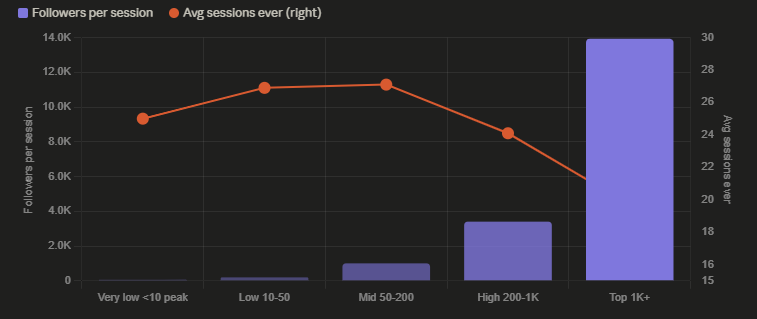
The followers-per-session figures describe a power law more extreme than any other metric in this series. A streamer whose historical peak audience has reached 1,000+ viewers accumulates an average of 13,940 followers per session. A streamer whose historical peak has never exceeded 10 viewers accumulates 66.5 per session — a ratio of 209 to one.
The session count column makes the compounding dynamic explicit. Top-tier streamers have completed an average of 19.7 historical sessions. Very-low-tier streamers have completed 25.0 — more sessions, dramatically less accumulation. The hours tell the same story: top-tier streamers average 65.6 total hours, very-low-tier streamers average 37.5. The output difference is not explained by more time or more sessions on the part of top performers. It is explained entirely by what happens during those sessions.
This is not a finding about what high performers are doing differently after they reach top-tier status. It is a finding about the relationship between peak audience quality and follower conversion that appears to be established very early in a streaming career and compounds from there.
Efficiency Is More Predictive Than Volume
The followers-per-session efficiency data separates streamers by outcome quality rather than effort level — and the results challenge the assumption that persistence eventually produces results.
| Efficiency tier | Streamers | Avg followers | Avg max viewers | Avg sessions | Avg hours |
|---|---|---|---|---|---|
| Ultra-high (5K+/session) | 3,072 | 271,974 | 2,534.0 | 20.1 | 69.9 |
| High (1K–5K/session) | 9,738 | 51,355 | 323.7 | 24.2 | 79.5 |
| Mid (200–1K/session) | 20,465 | 12,851 | 88.8 | 28.5 | 81.6 |
| Low (50–200/session) | 21,548 | 3,563 | 42.4 | 33.3 | 79.4 |
| Very low (<50/session) | 22,813 | 889 | 24.0 | 43.1 | 75.0 |
The inverse relationship between efficiency and session count is striking. Ultra-high efficiency streamers average 20.1 sessions. Very-low efficiency streamers average 43.1 — more than double. Both groups have broadcast roughly similar total hours (69.9 vs 75.0), but the very-low efficiency group has distributed those hours across more than twice as many sessions.
This pattern is consistent with the overstreaming dynamic documented throughout this series: higher frequency with lower quality produces worse outcomes than lower frequency with higher quality. But the efficiency data adds a dimension that session frequency alone does not capture — the relationship is not just about sessions per week, but about the fundamental audience quality that each session achieves. Very-low efficiency streamers are not simply broadcasting too often; they are broadcasting sessions that generate minimal follower conversion regardless of frequency.
The average max viewers column confirms this. Ultra-high efficiency streamers have a historical peak of 2,534 viewers. Very-low efficiency streamers have a historical peak of 24. The efficiency gap reflects audience scale differences, not strategic differences in how often people choose to broadcast.
The Time Investment Paradox
The hours-tier analysis produces the most direct evidence of diminishing returns in the dataset.
| Hours tier | Streamers | Avg followers | Avg max viewers | Avg sessions | Followers/hour |
|---|---|---|---|---|---|
| Very few (<10h) | 22,650 | 2,547 | 32.4 | 8.6 | 42.4 |
| Few (10–50h) | 37,787 | 17,814 | 189.9 | 17.6 | 296.3 |
| Moderate (50–200h) | 43,473 | 25,929 | 205.4 | 38.9 | 431.2 |
| Many (200–500h) | 2,804 | 26,832 | 139.5 | 93.1 | 446.2 |
| Extensive (500h+) | 14 | 232,145 | 1,693.4 | 110.1 | 3,860.8 |
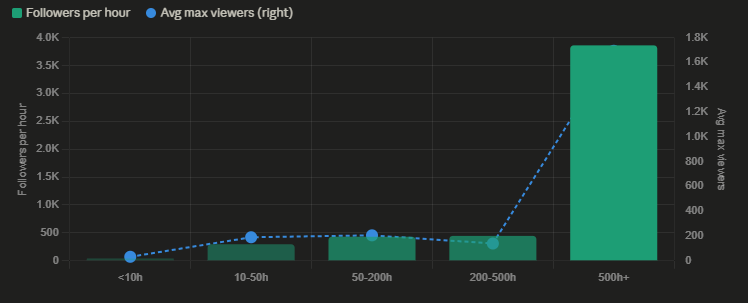
The followers-per-hour figure rises sharply from 42.4 (under 10 hours) to 296.3 (10–50 hours), then plateaus almost completely between 50–200 hours (431.2) and 200–500 hours (446.2). A streamer who has broadcast 51 hours and one who has broadcast 499 hours are producing nearly identical followers per hour — despite a tenfold difference in total time invested.
The 500-hour+ group — only 14 streamers in the dataset — jumps to 3,860.8 followers per hour and 1,693.4 average max viewers. This outlier group represents streamers who have invested extraordinary time and achieved extraordinary outcomes, but the causal relationship is ambiguous: did the hours produce the performance, or did high-performance streamers who happened to broadcast for 500+ hours self-select into this group? With only 14 data points, no conclusion is statistically reliable.
The plateau between 50 and 500 hours is the most actionable finding. It suggests that for the vast majority of streamers, increasing total broadcast hours beyond 50 does not produce proportionally better outcomes. The investment of hours 51 through 500 returns roughly the same per-hour yield as hours 10 through 50. If a streamer's session quality is not improving over this range — if the audiences they are attracting are not growing — more hours is not the solution.
Session Length and Follower Tier: A Two-Way Relationship
The follower-tier data adds the session length dimension to the trajectory analysis.
| Follower tier | Streamers | Avg session hours | Avg followers | Avg max viewers | Avg total sessions |
|---|---|---|---|---|---|
| Micro (<1K) | 36,748 | 1.56h | 339 | 21.7 | 18.7 |
| Small (1K–10K) | 42,992 | 2.43h | 3,864 | 49.1 | 31.4 |
| Mid (10K–100K) | 23,057 | 3.03h | 30,887 | 210.5 | 29.8 |
| Large (100K+) | 3,913 | 3.38h | 267,259 | 2,425.6 | 24.1 |
The average session length increases monotonically with follower tier: 1.56 hours at micro, 3.38 hours at large. This pattern has appeared in earlier analyses and the interpretation remains the same as before: it is not clear whether longer sessions cause better outcomes or whether streamers with larger audiences sustain sessions longer because their audiences remain engaged.
What this data adds is the total sessions column. Mid-tier streamers (29.8 sessions) and large-tier streamers (24.1 sessions) have completed fewer total historical sessions than small-tier streamers (31.4). This is consistent with the peak-tier analysis: larger-audience streamers reach their current tier in fewer sessions because each session converts at a higher rate, not because they have broadcast more frequently.
The micro-tier average of 18.7 total sessions — combined with 1.56-hour average sessions — describes the entry condition: short, frequent broadcasts that accumulate slowly. The transition from micro to small tier appears to require not just more sessions but longer sessions at higher quality — a shift in what each session achieves rather than simply more of the same.
What Predicts Trajectory: A Summary
Across four analytical dimensions, the data consistently identifies peak session quality — measured by historical maximum viewers — as the primary predictor of long-term follower accumulation. The mechanism appears to operate as follows.
Streamers who achieve high peak audiences early convert a larger proportion of those viewers to followers per session. This produces a higher base from which subsequent sessions start — more subscribers to notify when the next broadcast begins, more established presence in the platform's recommendation signals, more social proof for browse-in viewers who see a large audience and choose to join.
Streamers who achieve low peak audiences convert at the same low rate across many sessions. The follower base grows slowly, reducing the subscriber notification base for future sessions, limiting recommendation visibility, and reducing browse-in conversion for new viewers.
The compounding dynamic is self-reinforcing in both directions. High early performance creates conditions for continued high performance. Low early performance creates conditions where improvement requires breaking out of the low-performance equilibrium through some external factor — a viral session, cross-platform promotion, algorithmic promotion — rather than through incremental improvement.
This does not mean early trajectory is fixed. The examples throughout this series — streamers who achieved rapid follower accumulation from near-zero bases, new entrants who broke into the high-median tier within weeks — demonstrate that step-changes do occur. But the data does not show that sustained incremental effort at low performance levels eventually compounds into high performance. The followers-per-session figures suggest that each session produces outcomes roughly proportional to the audience quality it achieves, and that audience quality is not consistently improving over the 20–40 session range where most streamers spend their careers.
The Practical Implication
The growth accelerator data produces one clear practical implication and one uncomfortable acknowledgment.
The implication: the most important strategic decision available to a new streamer is not frequency, timing, or tag selection — it is creating the conditions for at least one session that significantly outperforms their baseline. A session that achieves 10x their typical peak audience, however brief and however driven by external factors, can produce a step-change in follower base that compounds forward. The per-session efficiency data shows that streamers in the high-efficiency tier produce 71 times the followers per session of very-low-efficiency streamers. Getting into the high-efficiency tier, even temporarily, matters more than optimizing the low-efficiency sessions that precede it.
The acknowledgment: the data does not show a reliable path from very-low-efficiency to high-efficiency through incremental effort alone. The peak viewer tiers are associated with different levels of platform infrastructure, audience composition, and geographic factors that cannot be replicated through session frequency or scheduling adjustments. The structural conditions that produce high peak audiences are substantially outside the control of most new streamers.
What is within control — and what the data consistently shows matters — is session quality within whatever structural conditions a streamer operates. Among streamers in the same follower tier, same geography, and same category, those who achieve higher per-session peak audiences accumulate followers more rapidly. The ceiling may be structurally constrained; the path to that ceiling is not.
Data sourced from models table reflecting current follower counts, historical session records, and historical maximum viewer data as of April 27, 2026. Analysis restricted to streamers with at least five historical sessions and 30 days of activity within the observation window. The 500h+ group contains 14 streamers and should be interpreted cautiously given the small sample size.