
The Golden Hour Decoded: Supply and Demand at the Day-Hour Level
Monday 21:00 UTC produces 35.15 viewers per model — the highest single day-hour combination in two weeks of data. Sunday 22:00 UTC reaches 33.21. But the most extreme single reading in the dataset is Sunday April 26 at 71.30 — nearly double the two-week average. The difference between the best and worst hour on the same day can be the difference between 23 viewers per model and 71.
Earlier analyses in this series identified broad timing patterns: Sunday is better than Wednesday, 10:00–11:00 UTC outperforms 19:00–20:00 UTC on a viewers-per-model basis. This week's data allows a more precise breakdown — every hour of every day of the week over two weeks — revealing combinations that the weekly averages concealed.
The Best Day-Hour Combinations
Ranking every hour-day combination by viewers per model across two weeks produces a top-20 that is heavily dominated by Monday and Sunday.
| Hour (UTC) | Day | Avg streamers | Avg viewers | VPM | Avg peak |
|---|---|---|---|---|---|
| 21:00 | Monday | 8,959 | 314,933 | 35.15 | 7,852 |
| 21:00 | Sunday | 6,619 | 231,617 | 34.99 | 4,399 |
| 10:00 | Monday | 5,145 | 179,926 | 34.97 | 2,985 |
| 18:00 | Monday | 6,935 | 242,178 | 34.92 | 5,819 |
| 22:00 | Monday | 9,115 | 315,309 | 34.59 | 7,911 |
| 22:00 | Sunday | 6,228 | 214,361 | 34.42 | 3,677 |
| 20:00 | Sunday | 6,811 | 232,065 | 34.07 | 5,913 |
| 19:00 | Monday | 7,550 | 256,816 | 34.02 | 6,686 |
| 11:00 | Monday | 5,519 | 186,233 | 33.74 | 3,350 |
| 19:00 | Sunday | 6,900 | 232,063 | 33.63 | 5,259 |
| 09:00 | Monday | 5,458 | 183,083 | 33.54 | 2,780 |
| 03:00 | Saturday | 7,185 | 240,309 | 33.45 | 4,671 |
| 08:00 | Monday | 5,815 | 193,803 | 33.33 | 3,230 |
Monday dominates the top 10 in a way that the weekly aggregate data does not fully capture. The weekly Sunday advantage documented in earlier analyses is real but narrower than it appeared: Sunday produces strong efficiency in the evening hours, but Monday's daytime and evening hours consistently outperform every other day including Sunday.
The explanation lies in supply dynamics. Monday 10:00 UTC averages only 5,145 streamers — the second-lowest streamer count of any entry in the top 20 — while achieving a VPM of 34.97. The combination of reduced supply (many streamers who broadcast heavily on weekends are not yet active Monday morning) and sustained demand from the preceding weekend's viewer base produces an efficiency window that is genuinely underappreciated.
Monday 21:00–22:00 UTC tells a different story: 8,959–9,115 streamers online — among the highest supply counts in the dataset — yet still achieving VPM above 34. Here it is demand driving the efficiency: total viewers of 314,933–315,309 are among the highest recorded, sufficient to sustain high per-model density despite the large streamer count.
Weekday vs Weekend: Where the Real Gaps Are
The aggregate weekday-versus-weekend comparison reveals the efficiency crossover points that are most actionable for scheduling decisions.
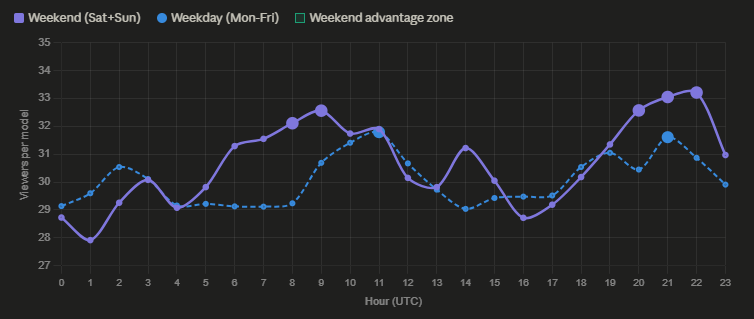
| Hour (UTC) | Weekday VPM | Weekend VPM | Advantage |
|---|---|---|---|
| 06:00 | 29.13 | 31.29 | Weekend +2.16 |
| 07:00 | 29.12 | 31.55 | Weekend +2.43 |
| 08:00 | 29.24 | 32.11 | Weekend +2.87 |
| 09:00 | 30.69 | 32.56 | Weekend +1.87 |
| 10:00 | 31.41 | 31.74 | Weekend +0.33 |
| 11:00 | 31.79 | 31.90 | Weekend +0.11 |
| 14:00 | 29.04 | 31.22 | Weekend +2.18 |
| 20:00 | 30.45 | 32.57 | Weekend +2.12 |
| 21:00 | 31.61 | 33.05 | Weekend +1.44 |
| 22:00 | 30.87 | 33.21 | Weekend +2.34 |
| 13:00 | 29.73 | 29.82 | Near parity |
| 15:00 | 29.43 | 30.05 | Weekend +0.62 |
The weekend advantage is concentrated in two windows: the early morning block from 06:00–09:00 UTC, and the late evening block from 20:00–22:00 UTC. In both windows, weekend VPM exceeds weekday by approximately 2–3 points — meaningful at a platform where the overall range runs from roughly 25 to 35.
The 10:00–11:00 UTC window shows near parity between weekdays and weekends, suggesting that the morning efficiency peak documented in earlier analyses operates similarly across all days of the week. The advantage at this hour comes from low supply rather than day-of-week demand patterns.
The 13:00–17:00 UTC window — the European afternoon window — shows weekends performing at or below weekday levels for much of the range. This is the window where European viewers are most active, and weekday demand appears to be sufficient to match or exceed weekend supply-demand dynamics.
The Couple Premium at Every Hour
The gender-specific VPM data this week produces the most extreme differential in the entire dataset.
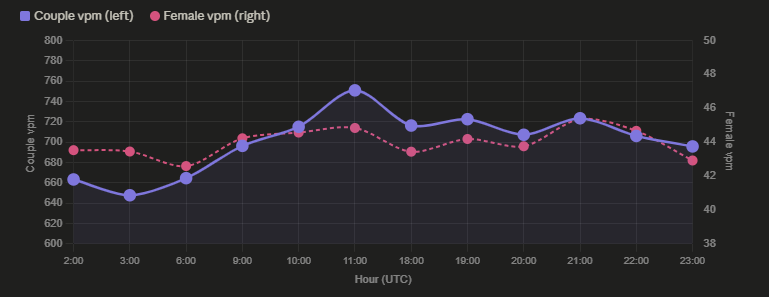
| Hour (UTC) | Female VPM | Couple VPM | Ratio |
|---|---|---|---|
| 11:00 | 44.84 | 751.04 | 16.8x |
| 10:00 | 44.57 | 715.17 | 16.0x |
| 21:00 | 45.36 | 723.57 | 15.9x |
| 19:00 | 44.19 | 722.64 | 16.4x |
| 18:00 | 43.44 | 716.40 | 16.5x |
| 22:00 | 44.67 | 706.16 | 15.8x |
| 03:00 | 43.45 | 647.79 | 14.9x |
| 06:00 | 42.59 | 664.61 | 15.6x |
At every hour in the dataset, couple streamers achieve between 14.9x and 16.8x the viewers-per-model ratio of female streamers. The couple VPM ranges from 647.79 at 03:00 UTC to 751.04 at 11:00 UTC — a relatively narrow absolute range that indicates the couple advantage is structural rather than time-dependent.
The 11:00 UTC peak of 751.04 coincides with the platform-wide morning efficiency window. When fewer streamers are online and viewers are distributed more favorably, couple streamers benefit proportionally — but the base advantage is already so large that the incremental gain from timing is modest relative to the category premium itself.
Female VPM ranges from 42.59 at 06:00 UTC to 45.36 at 21:00 UTC — a variation of only 2.77 points across 24 hours. Timing matters for female streamers, but within a narrow absolute range. The category decision is approximately 15 times more impactful than the timing decision for this gender category.
The Day-Level Extremes
The daily data reveals the range of within-day variation that aggregate weekly numbers conceal.
| Date | Day | Best VPM | Worst VPM | Avg VPM | Peak viewers | Min streamers |
|---|---|---|---|---|---|---|
| Apr 20 | Monday | 44.84 | 28.72 | 35.93 | 383,221 | 5,128 |
| Apr 21 | Tuesday | 41.53 | 27.76 | 33.95 | 380,607 | 5,814 |
| Apr 22 | Wednesday | 41.15 | 23.30 | 31.80 | 378,217 | 5,294 |
| Apr 23 | Thursday | 40.21 | 25.04 | 31.03 | 397,335 | 5,370 |
| Apr 24 | Friday | 41.72 | 27.14 | 33.39 | 266,418 | 4,940 |
| Apr 25 | Saturday | 54.71 | 24.25 | 31.96 | 473,750 | 4,927 |
| Apr 26 | Sunday | 71.30 | 23.45 | 27.50 | 394,494 | 5,533 |
| Apr 27 | Monday | 29.68 | 25.21 | 27.07 | 265,357 | 7,079 |
Three findings from this table deserve individual attention.
April 25 (Saturday) produced a peak total viewer count of 473,750 — the highest single reading in the entire dataset. This demand spike, combined with a minimum streamer count of only 4,927, produced a best-hour VPM of 54.71. The combination of record demand and low supply in the same measurement window is rare and unlikely to be predictable in advance.
April 26 (Sunday) produced a best-hour VPM of 71.30 — also the highest single-hour reading in the dataset. The worst-hour VPM on the same day was 23.45, a within-day range of 47.85 points. For a streamer broadcasting on Sunday April 26, the difference between the best and worst hour was the difference between 71 and 23 viewers per model — a 3x swing on the same day.
April 27 (Monday) shows an avg VPM of only 27.07, substantially below the April 20 Monday average of 35.93. This inconsistency between two Mondays highlights a key limitation of day-of-week planning: the day-level patterns documented in earlier analyses represent averages across many weeks, and individual instances can deviate significantly. The April 27 Monday underperformance likely reflects the tail end of an unusual demand event from the preceding weekend rather than any systematic Monday effect.
Translating Data Into Schedule Decisions
The combination of day-hour, weekday-weekend, and category data this week produces the most specific timing framework the series has generated.
For couple streamers: The category premium of 15–17x female VPM is so large that timing optimization is secondary. Broadcasting at 11:00 UTC (751 VPM) versus 03:00 UTC (648 VPM) represents a 16% improvement — meaningful, but small relative to the structural advantage of being in the couple category at all. Any hour produces dramatically better efficiency than female streamers achieve at their best hour.
For female streamers: The within-category timing range is narrow (42.6–45.4 VPM), but the day-of-week effect is more significant than hourly variation. Monday and Sunday evening slots (19:00–22:00 UTC) consistently outperform Tuesday through Thursday. The weekend morning advantage (06:00–09:00 UTC, weekend VPM 31–32.6 vs weekday 29.1–29.2) represents a genuine scheduling opportunity for streamers with flexible schedules.
For all categories: The within-day VPM range of up to 47 points on a single day means that an 8:00 UTC start on Sunday can produce radically different conditions than a 14:00 UTC start on the same day. The average figures mask this variance. Streamers optimizing for efficiency should prioritize the low-supply windows — Monday morning, Sunday evening — over the high-volume windows where supply and demand both peak simultaneously.
What Timing Optimization Cannot Do
The precision timing data in this analysis produces the most specific scheduling recommendations of the series. It cannot resolve the fundamental constraint that has appeared in every timing analysis: timing optimization works within the category and follower-base conditions a streamer already occupies.
A female streamer with 1,000 followers broadcasting at Monday 21:00 UTC will achieve a VPM of approximately 34–35 in platform terms — but her personal VPM reflects her specific audience, which is a fraction of the platform aggregate. The platform-level VPM indicates competitive conditions, not guaranteed outcomes.
The couple VPM of 751 at 11:00 UTC does not mean every couple stream at that hour achieves 751 viewers. It means the average viewer-to-streamer ratio within the couple category at that hour is 751 — driven by the top performers pulling the average up substantially. A new couple stream at 11:00 UTC benefits from the reduced competition that produces the high platform-level VPM, but their actual audience reflects their specific follower base and discoverability.
Timing is the most immediately adjustable variable available to any streamer. It is also, as this series has established consistently, among the least powerful relative to category selection, follower accumulation, and session quality.
Data sourced from site_sync_stats covering April 20–27, 2026, encompassing approximately 2,400 sync events at 8-minute intervals. VPM calculated as total_viewers divided by total_online at each sync event, averaged across the hour-day combination. Gender-specific VPM calculated as total_viewers divided by gender-specific online count.