
The Couple Streaming Advantage: Scarcity, Quality, or Something Else?
In a market where the average streamer is fighting for 26 viewers, one category consistently attracts 60. The data is clear. The reason behind it is more complicated than it first appears — and we ran four additional tests to find out which explanation holds.
When we published last week's analysis on the platform's worsening supply-demand imbalance, one data point stood out. Couple streamers — representing less than 5% of all active streamers — were maintaining average audiences more than three times larger than the platform's most populous category.
This week we looked deeper. We identified four competing explanations for the advantage, then designed specific data tests for each one. The results eliminated two explanations, cast doubt on a third, and left one standing as the most defensible account of what is actually happening.
The Basic Disparity
This week's gender distribution data establishes the baseline.
| Category | Active streamers | Avg median viewers | Avg peak viewers | Total hours |
|---|---|---|---|---|
| Couple | 4,227 | 60.4 | 135.0 | 34,297 |
| Female | 46,014 | 17.5 | 31.8 | 568,173 |
| Trans | 6,747 | 10.2 | 18.7 | 67,716 |
| Male | 31,903 | 9.9 | 17.4 | 133,045 |
Couple streamers are outnumbered by female streamers nearly eleven to one. They account for roughly 6% of active streamers this week. Yet their median audience is 3.4 times larger than female streamers, 5.9 times larger than trans streamers, and 6.1 times larger than male streamers.
One additional pattern in this table deserves attention before moving on. Couple streamers average 8.1 hours of total broadcasting per person this week. Female streamers average 12.3 hours — roughly 33% more time online.
This matters because it introduces a self-imposed scarcity that operates independently of how many couple streamers exist on the platform. Viewers who want couple content have fewer total hours of it available to consume. Whether this is a deliberate strategy or a natural consequence of the coordination demands of two-person streaming, the effect is the same: audience attention concentrates into fewer, higher-value sessions. The high median audience figure may partly reflect this time scarcity rather than — or in addition to — category scarcity.
Four Competing Explanations
Before testing the data, it is worth laying out the four most plausible explanations for the audience advantage — because they point toward very different practical implications.
Explanation 1: Scarcity. Fewer couple streamers means less competition for the audience that actively seeks couple content. When a viewer with that preference browses the platform, they have fewer options, and each individual couple streamer captures more of that demand.
Explanation 2: Content density. Two people interacting on camera creates inherently more dynamic content than a single person. The complexity of interpersonal dynamics, the unpredictability of two-person chemistry, and the broader range of possible scenarios make couple content more engaging per unit of viewing time — independent of how many couple streamers exist.
Explanation 3: Production sustainability. Two people share the cognitive and emotional load of being live. Solo streamers who broadcast too frequently degrade in quality because one person has finite energy and creative bandwidth. Two people can sustain more without burnout — making couple streaming structurally more resilient to frequency and duration.
Explanation 4: Selection quality. Maintaining a stable two-person streaming operation requires significantly more coordination than solo streaming. The 4,227 couple streamers in this week's data are not a random sample of the streaming population — they are the subset who have successfully navigated the logistics, relationship dynamics, and technical requirements of streaming together consistently. The audience advantage may reflect this pre-selection of higher-quality producers rather than anything inherent to the category.
Test 1 — Does the Advantage Exist Before Audience Accumulation?
The first test uses follower count as a proxy for accumulated audience history. If the advantage appears even among streamers with almost no followers, it cannot be driven primarily by past success compounding into present results.
| Follower tier | Couple avg median | Female avg median | Premium |
|---|---|---|---|
| Under 1K | 13.0 | 4.5 | 2.9x |
| 1K–10K | 23.6 | 7.1 | 3.3x |
| 10K–50K | 53.2 | 18.6 | 2.9x |
| 50K–100K | 112.1 | 52.6 | 2.1x |
| Over 100K | 293.2 | 203.0 | 1.4x |
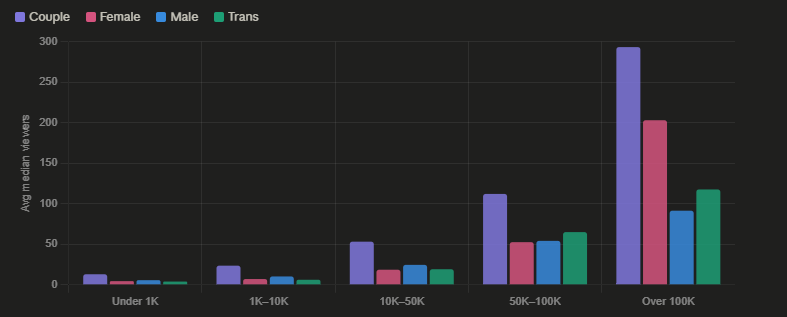
The advantage appears at every tier, including among streamers with under 1,000 followers. A 2.9x premium exists before either party has built any meaningful following. This rules out accumulated history as the primary driver — the advantage is present from the first session.
Verdict: The follower-tier data confirms the advantage is structural. It does not tell us which of the four explanations causes it.
Test 2 — Does the Premium Compress Predictably at Scale?
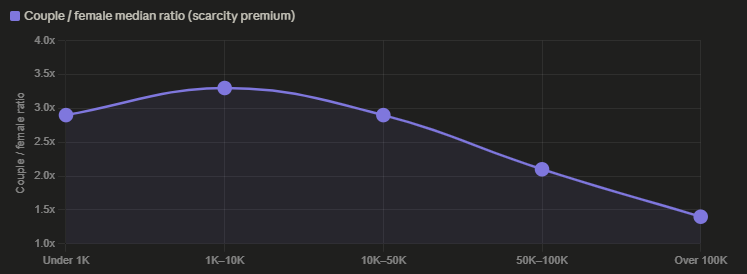
The premium peaks at 3.3x in the 1K–10K follower tier and compresses to 1.4x among streamers with over 100K followers. Two explanations predict this pattern — and they have different implications.
The scarcity explanation predicts compression because established streamers attract viewers through direct subscriptions rather than category browsing. As subscription-driven traffic dominates, the category advantage becomes less relevant.
An alternative explanation predicts the same compression for a different reason: couple content has a lower addressable audience ceiling than female content. The segment of viewers specifically seeking couple content may simply be smaller than the broader audience for female content. As couple streamers grow, they hit the limits of their niche audience — while successful female streamers can draw from a much larger pool.
If the second explanation is correct, the 1.4x advantage at over 100K followers is not a diminished scarcity effect — it is the ceiling of couple content's reach. The data cannot distinguish between these two interpretations of the same compression pattern.
Test 3 — Do Couple Streamers Retain Audiences Better?
If production sustainability is driving the advantage, couple streamers should show slower audience decay within sessions — their median audience should remain closer to their peak relative to solo streamers. We measure this as the median/peak ratio: a higher ratio means the audience that arrives at peak stays through more of the session.
| Session length | Couple median/peak | Female median/peak |
|---|---|---|
| Under 1h | 52.7% | 64.3% |
| 1–2h | 49.8% | 60.3% |
| 2–4h | 45.2% | 57.4% |
| 4–8h | 38.3% | 53.9% |
| Over 8h | 39.9% | 51.4% |
The production sustainability hypothesis predicts that couple streamers should show higher median/peak ratios — more stable audiences, less decay. The data shows the opposite. At every session length, female streamers maintain a higher proportion of their peak audience through the session than couple streamers do.
Couple streamers attract larger absolute audiences, but those audiences decay faster relative to peak. The pattern is consistent with content that creates a strong initial draw — people browse in out of curiosity — but does not hold viewers as reliably as content that rewards sustained watching.
Verdict: Production sustainability hypothesis weakened. Couple streamers do not retain audiences better than female streamers. The advantage is in attraction, not retention.
Test 4 — Is the Advantage Driven by Producer Quality Selection?
The selection quality hypothesis predicts that the couple advantage should grow with experience — more established couple operations should show a larger premium because the selection filter has had more time to eliminate lower-quality producers.
We use follower count as a proxy for streamer maturity, dividing the population into four tiers by scale.
| Tier | Couple avg median | Female avg median | Premium |
|---|---|---|---|
| Micro (<5K followers) | 16.7 | 5.5 | 3.0x |
| Small (5K–20K) | 36.6 | 10.9 | 3.4x |
| Mid (20K–100K) | 81.2 | 33.2 | 2.4x |
| Large (100K+) | 291.7 | 203.1 | 1.4x |
If selection quality is the primary driver, the premium should be smallest among micro-tier streamers — the level where both categories contain the most unfiltered new entrants — and largest among mid-tier streamers where experience has had time to consolidate.
Instead, the micro tier already shows a 3.0x premium, comparable to the small tier's 3.4x and larger than the mid tier's 2.4x. The advantage is present and substantial from the very beginning of a streaming career, before any meaningful selection process could have operated.
Verdict: Selection quality hypothesis partially weakened. The premium does not grow with streamer maturity in the way selection quality would predict. It exists from day one, which is more consistent with an inherent content advantage than with accumulated quality filtering.
What the Tests Tell Us: Content Density Remains Standing
After four tests, the scorecard looks like this:
| Hypothesis | Prediction | Result | Verdict |
|---|---|---|---|
| Scarcity | Premium driven by browse discovery | Cannot confirm — time-slot data confounded by platform-wide patterns | Unresolved |
| Content density | Strong initial draw, present from first session | Premium exists at micro tier (3.0x) from day one | Not weakened |
| Production sustainability | Higher median/peak ratio than female streamers | Couple ratio lower at every session length | Weakened |
| Selection quality | Premium grows with streamer maturity | Premium flat or declining across tiers | Weakened |
Content density is the last explanation standing — not because we proved it, but because it is the only one the data has not damaged. Two people on camera create a more compelling browse-in moment than one person. Viewers enter couple streams at higher rates. They do not stay proportionally longer than in female streams — but they arrive in greater numbers, and that difference is what drives the median audience gap.
This interpretation is consistent with the session-length data: if content density creates a strong entry pull rather than a retention advantage, you would expect exactly what we see — high peaks relative to female streamers, but faster decay from those peaks.
It is also consistent with the time-on-platform data: couple streamers spend 33% fewer hours online than female streamers, yet attract 3.4x the audience. The per-hour efficiency of couple streaming is dramatically higher — which is what strong initial draw without proportional retention would produce.
The Geography Question — And Its Limits
| Country | Streamers | Avg median viewers | Avg peak viewers |
|---|---|---|---|
| Canada | 99 | 106.7 | 212.1 |
| France | 41 | 104.8 | 193.1 |
| Brazil | 54 | 99.8 | 196.4 |
| Unknown | 1,724 | 98.4 | 204.8 |
| Venezuela | 56 | 76.7 | 181.2 |
| Argentina | 42 | 79.7 | 175.8 |
| GB | 90 | 66.8 | 138.1 |
| US | 1,104 | 58.5 | 129.9 |
| Colombia | 1,441 | 36.1 | 92.8 |
| Philippines | 91 | 9.7 | 18.0 |
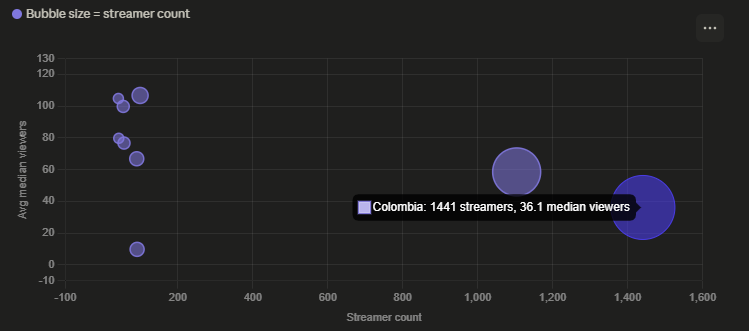
Colombia has the largest number of couple streamers at 1,441 but the lowest average median audience among major countries at 36.1. Canada has 99 streamers and achieves 106.7. The geographic spread is wide enough to suggest that category membership alone does not guarantee the audience advantage — execution, production quality, language, and equipment all introduce variation that the category label cannot override.
The unknown-country group — 1,724 streamers — achieves 98.4 median viewers, among the highest of any group. Large-scale streaming operations — studios managing multiple couple accounts with dedicated technical infrastructure — routinely withhold location data as standard practice for tax, privacy, and platform policy reasons. If a meaningful proportion of this group consists of professionally managed operations rather than independent couples, their strong performance reflects organizational investment rather than individual chemistry. This would represent the strongest version of the selection quality argument operating not at the individual level but at the institutional level: professional studios have identified couple content as a high-return format and built dedicated production capacity around it.
Geographic patterns in this data are real but should be treated as correlates rather than causes.
The Top Performers This Week
| Streamer | Sessions | Total hours | Median viewers | Peak viewers | Followers |
|---|---|---|---|---|---|
| milly____ | 3 | 7.3h | 3,374 | 4,661 | 380,952 |
| french_riv1era | 4 | 11.5h | 3,169 | 4,614 | 420,938 |
| dellris | 11 | 34.0h | 3,123 | 4,318 | 49,336 |
| cumplaycouple | 3 | 5.4h | 3,062 | 3,976 | 475,507 |
| busbuddies | 2 | 2.6h | 2,967 | 4,343 | 353,230 |
| taloulah | 4 | 10.7h | 2,708 | 3,838 | 12,818 |
| loving_ladies | 1 | 6.3h | 2,652 | 4,835 | 559,068 |
| denobluora | 4 | 13.8h | 2,609 | 3,969 | 281,875 |
| indulgencex | 5 | 20.2h | 2,572 | 4,896 | 242,104 |
| lucycums | 5 | 12.9h | 2,562 | 4,308 | 575,904 |
taloulah remains the most analytically interesting case: 12,818 followers, yet a median audience of 2,708 — roughly 50 times the average for their follower tier. No category advantage and no selection filter explains a 50x outperformance within the same tier. Something specific to their content or execution is operating at a level that the aggregate data cannot capture.
dellris, streaming 11 times for 34 total hours, achieves a median of 3,123 despite a schedule that devastates female streamer performance. This is consistent with a content density advantage rather than a production sustainability one — the draw is strong enough to partially offset the frequency penalty, rather than frequency being inherently sustainable for two-person operations.
The Variable This Analysis Cannot Address
There is one metric this analysis does not have access to that would materially change the practical conclusions: revenue per person.
Couple streaming requires two people to commit time, energy, and exposure. If the audience advantage translates proportionally into revenue — and if that revenue is split between two people — the per-person economic outcome of couple streaming may be comparable to or below that of successful solo streaming, despite the apparent audience advantage.
The 3x audience density figure is not a 3x income figure. Two people achieving a median audience of 60 are not individually better off than one person achieving a median audience of 30, unless the revenue relationship is non-linear or couple content commands meaningfully higher per-viewer spending. We do not have the data to evaluate this.
Any practical decision about whether to pursue couple streaming should account for the cost structure as well as the audience advantage. The category premium is real in the audience data. Whether it translates into a genuine economic advantage for the individuals involved is a separate question that this analysis cannot answer.
What the Data Actually Supports
Supported: Couple streamers consistently attract larger audiences than solo streamers of any gender, at every follower tier, under every frequency pattern measured this week. This advantage is structural and appears from the earliest stages of a streaming career. Part of this advantage may also stem from couple streamers spending 33% fewer hours online per person — 8.1 hours versus 12.3 for female streamers — which concentrates audience attention into fewer, higher-value sessions.
Most likely explanation: Content density — the inherent draw of two-person interaction — creates stronger browse-in rates than solo content. This is supported by the micro-tier premium (3.0x from day one), is consistent with the high peak-to-median decay pattern, and has not been weakened by any of the four tests.
Explanations weakened by data: Production sustainability (couple streamers show faster audience decay, not slower) and selection quality (premium does not grow with streamer maturity).
Explanation unresolved: Scarcity — plausible but confounded by time-slot effects that prevent clean measurement.
Not supported: That entering the couple category will reliably produce a 3x audience advantage for any two people who decide to stream together. The micro-tier data (avg_median 16.7 for couple streamers with under 5K followers) shows that the category floor is not high — the aggregate advantage is driven significantly by the upper tiers pulling the average up.
Not addressed: Whether the audience advantage translates into proportionally better economic outcomes once the two-person cost structure is accounted for.
Data sourced from real-time platform analytics covering April 6–13, 2026. Gender classifications reflect platform-reported categories. Country data reflects streamer-reported location, with a significant proportion unreported. All viewer counts reflect concurrent viewers at time of measurement. Median/peak ratio analysis based on 396,385 completed sessions across both gender categories.