
The Overstreaming Paradox: Why Broadcasting More Is Hurting Your Numbers
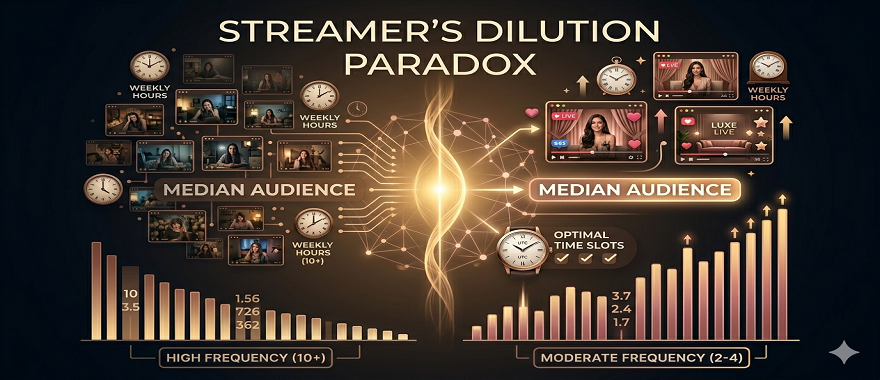
Every struggling streamer's first instinct is to stream more. Show up every day. Fill every hour. Be impossible to miss. The data says this instinct is wrong — and the numbers reveal exactly why.
This week we analyzed the session records of over 100,000 streamers, grouping them by how many times they went live in a seven-day period. What we found challenges one of the most common pieces of advice in streaming: that consistency means frequency.
It does not.
The Core Finding
| Sessions per week | Streamers | Avg median viewers | Avg peak viewers | Avg P90 viewers | Avg total hours |
|---|---|---|---|---|---|
| Moderate 2–4 | 35,729 | 43.2 | 79.2 | 66.9 | 7.0 |
| Active 5–9 | 28,906 | 34.9 | 67.5 | 54.6 | 18.1 |
| Occasional 1 | 22,514 | 18.2 | 32.6 | 28.5 | 1.2 |
| Very Active 10+ | 13,675 | 19.4 | 36.7 | 30.2 | 25.8 |
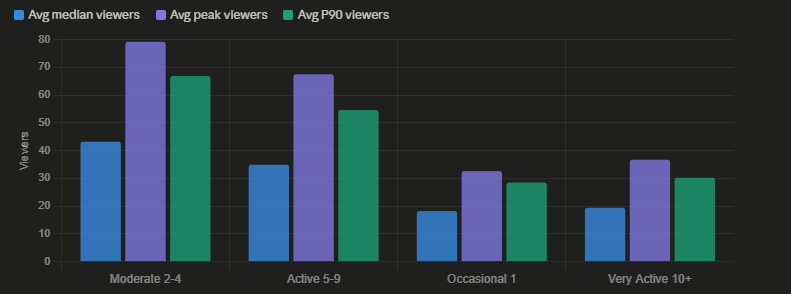
The pattern is striking. Streamers who broadcast 2–4 times per week achieve a median audience of 43.2 — more than double the 19.4 median of those streaming 10 or more times. Across every quality metric — median, peak, and P90 — the moderate group leads. The very active group, despite logging an average of 25.8 hours online per week, ranks last alongside those who streamed just once.
More hours. Worse results.
What These Numbers Actually Mean
Before drawing conclusions, it is worth being precise about what this data can and cannot tell us.
This is a correlation, not a proven cause. Two explanations are both plausible:
Explanation A — frequency causes quality loss. Streaming too often dilutes preparation, exhausts the streamer, and trains the audience to treat broadcasts as background noise rather than events. Reducing frequency would improve results for anyone.
Explanation B — selection effect. Streamers who already have large, loyal audiences do not need to stream constantly to maintain visibility. They stream 2–4 times because they can afford to. Streamers with smaller audiences compensate with volume. The frequency difference is a symptom of audience size, not a cause of it.
To test which explanation holds, we need to control for the obvious confounding variable: follower count.
Controlling for Follower Count
If the selection effect is the whole story, then within any given follower tier, frequency should not matter — a 10K-follower streamer streaming twice a week should perform identically to one streaming ten times a week.
The data shows something different.
| Follower tier | Moderate 2–4 | Active 5–9 | Very Active 10+ | Occasional 1 |
|---|---|---|---|---|
| Under 1K | 9.6 | 10.2 | 8.9 | 5.7 |
| 1K–10K | 17.5 | 16.2 | 13.1 | 13.4 |
| 10K–50K | 45.8 | 40.2 | 27.4 | 37.3 |
| 50K–100K | 115.7 | 95.2 | 70.1 | 95.5 |
| Over 100K | 438.2 | 270.7 | 193.7 | 384.3 |
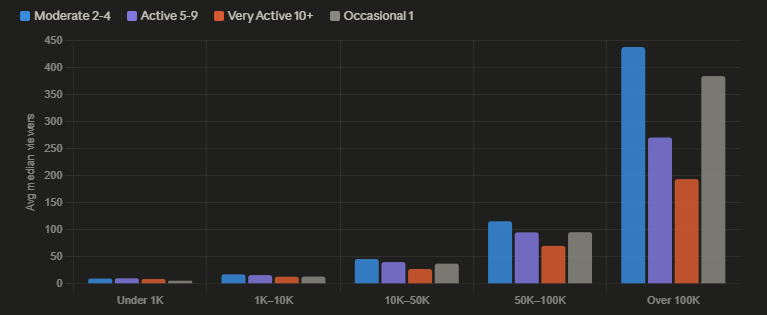
At every follower tier from 1K upward, the Moderate 2–4 group outperforms the Very Active 10+ group. The gap widens dramatically at higher follower counts: among streamers with over 100K followers, those streaming 2–4 times per week achieve a median audience of 438.2 — more than double the 193.7 of those streaming 10 or more times.
This rules out a pure selection effect. Frequency itself appears to matter, independent of how large your existing audience is.
The one exception is the Under 1K tier, where Active 5–9 narrowly leads (10.2 vs 9.6). For streamers just starting out with almost no followers, higher frequency may provide a marginal benefit — more sessions means more chances to be discovered. But this advantage disappears entirely once a meaningful follower base exists.
Why Over-Streaming Backfires
The data points toward several mechanisms, each reinforcing the others.
Audience habituation. When a streamer is always live, viewers stop treating sessions as events worth showing up for. The psychological pull of scarcity — "she only streams three times a week, I don't want to miss it" — disappears when availability is constant. Viewers who know a stream is always there tend to drop in briefly and leave, rather than settling in for a full session.
Quality dilution. A streamer preparing for two or three sessions per week has more recovery time, more material to work with, and more energy per broadcast than one who is live every day. Average session length data supports this: Very Active 10+ streamers average just 1.7 hours per session, compared to 2.3 hours for Moderate 2–4. Shorter sessions suggest either lower stamina or earlier drop-offs in audience engagement.
Platform supply contribution. As documented in our previous analysis, the platform currently has more streamers online at any given moment than viewer demand can support. Every additional hour any streamer spends live increases the total competition for a fixed pool of viewers. Over-streamers are not just hurting their own numbers — they are contributing to the supply pressure that drives everyone's viewers-per-model figure downward.
The Session Length Signal
| Sessions per week | Avg session hours | Max session hours |
|---|---|---|
| Active 5–9 | 2.9 | 17.3 |
| Moderate 2–4 | 2.3 | 25.4 |
| Very Active 10+ | 1.7 | 9.1 |
| Occasional 1 | 1.2 | 200.3* |
*The 200-hour outlier in the Occasional group is a data artifact from a session spanning a system restart — treat as noise.
The Very Active group's 1.7-hour average session length compared to the Moderate group's 2.3 hours suggests that high-frequency streamers are either cutting sessions short or losing their audiences faster. Neither is a sign of a sustainable strategy.
What the Best Performers Look Like
The top performers in the Moderate 2–4 category this week offer a useful reference point.
| Streamer | Sessions | Total hours | Avg session | Median viewers | Peak viewers |
|---|---|---|---|---|---|
| bailey_eilish | 2 | 6.3h | 3.1h | 5,721 | 7,693 |
| gracieparker | 2 | 2.8h | 1.4h | 5,374 | 6,852 |
| sugarpoppyxo | 4 | 17.1h | 4.3h | 5,281 | 8,283 |
| floret_joy | 3 | 7.9h | 2.6h | 4,892 | 7,820 |
| emyii | 4 | 9.3h | 2.3h | 4,504 | 5,998 |
These are not casual streamers. sugarpoppyxo ran four sessions averaging 4.3 hours each — serious, committed broadcasts. But she did not stream every day. The result was a median audience of 5,281 per session and 28,730 new followers gained in the same week.
Compare this to the top performers in the Very Active 10+ category:
| Streamer | Sessions | Total hours | Avg session | Median viewers |
|---|---|---|---|---|
| my_eyes_higher | 19 | 47.6h | 2.5h | 1,154 |
| cutie_n111 | 10 | 20.9h | 2.1h | 978 |
| oliviaocean69 | 13 | 27.9h | 2.1h | 917 |
| miss_hinata | 12 | 28.4h | 2.4h | 913 |
| anabel054 | 14 | 116.3h | 8.3h | 591 |
anabel054 spent 116 hours online this week — nearly five full days — and achieved a median audience of 591. That is a significant investment of time for a result that the Moderate group's median performer would consider a poor session.
Timing: When You Stream Matters Too
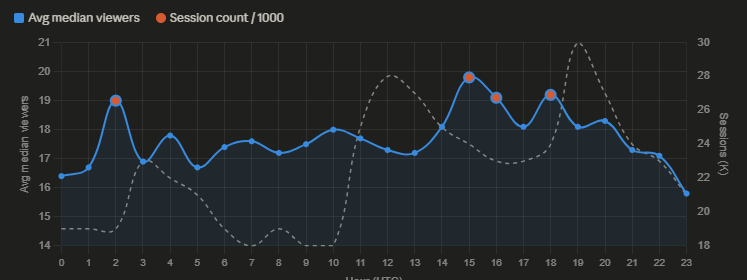
Beyond how often you stream, when you start matters. Hourly data across all sessions this week reveals a consistent pattern in audience quality.
| Hour (UTC) | Sessions | Avg median viewers | Avg peak viewers |
|---|---|---|---|
| 02:00 | 19,204 | 19.0 | 35.7 |
| 15:00 | 23,804 | 19.8 | 34.7 |
| 16:00 | 22,556 | 19.1 | 34.1 |
| 18:00 | 23,901 | 19.2 | 34.4 |
| 23:00 | 20,741 | 15.8 | 27.9 |
The highest-quality windows are 15:00–18:00 UTC (corresponding to late morning in the Americas and evening in Europe) and the early hours around 02:00 UTC. The late evening slot around 23:00 UTC consistently produces the weakest audiences despite reasonable session volume.
For a streamer choosing between two sessions per week, timing those sessions during the 15:00–18:00 UTC window rather than the 23:00 window could yield meaningfully better results — no change in frequency required.
Three Practical Takeaways
1. Find your sustainable frequency, then hold it
The data does not say "stream as little as possible." Occasional 1-session streamers underperform the Moderate group significantly. The sweet spot appears to be 2–4 sessions per week — enough to maintain audience relationship and platform visibility, not so much that sessions become routine background noise.
2. Invest in session quality, not session count
The Moderate group averages 7.0 total hours per week across 2–4 sessions. The Very Active group averages 25.8 hours. The Moderate group achieves better results with less than a third of the time investment. Those reclaimed hours can go into preparation, content planning, or simply recovery — all of which show up in session quality.
3. Choose your time slot deliberately
The 15:00–18:00 UTC window consistently produces the highest median audiences. If your schedule allows any flexibility, anchoring your sessions here rather than in the low-quality 22:00–23:00 UTC window is one of the easiest performance improvements available.
The Bigger Picture
This analysis connects directly to last week's finding on viewers-per-model compression. The platform currently has more supply than demand can absorb. Every streamer who reduces their hours from 25 per week to 7 is not just improving their own numbers — they are fractionally reducing the competitive pressure on everyone else.
Markets self-correct through exactly this mechanism: diminishing returns eventually convince participants to scale back, supply falls, and the remaining players find conditions improving. The streamers who recognize this dynamic early and adjust their strategy accordingly will be better positioned when that correction arrives.
The data is clear. More is not more. Better is more.
Data sourced from real-time platform analytics covering April 5–12, 2026. Analysis includes 100,918 streamers with at least one completed session during the measurement period. Median viewers calculated from per-session sampling data collected at 8-minute intervals.